ABOUT MONTESSORI
ABOUT MONTESSORI
where it all started
where it all started
“The role of education is to interest the child profoundly in an external activity to which he can give all his potential”
– Maria Montessori
Maria Montessori who lived from 1870 to 1952 was a brilliant and original educator, scientist, teacher, humanitarian and philosopher.
She pioneered a radical approach to education based on the scientific study of how children grow and learn, and the design of living and learning environments that meet their changing developmental needs.
Maria Montessori believed that no person is educated by another – he must do it by himself or it will never be done. A child is born with a natural innate desire to learn – a natural curiosity and desire for knowledge, the “absorbent mind”. Dr. Montessori designed manipulative materials for all subject areas, activities which children experience sensorially and interactively. The materials in the environment build on each other in increasing complexity as part of a natural progression. All new concepts are introduced in a concrete way and the child moves towards abstraction at his own pace. All subject matter is presented in an integrated way so that the child sees how all things are inter-related.
Maria Montessori believed that no person is educated by another – he must do it by himself or it will never be done. A child is born with a natural innate desire to learn – a natural curiosity and desire for knowledge, the “absorbent mind”. Dr. Montessori designed manipulative materials for all subject areas, activities which children experience sensorially and interactively. The materials in the environment build on each other in increasing complexity as part of a natural progression. All new concepts are introduced in a concrete way and the child moves towards abstraction at his own pace. All subject matter is presented in an integrated way so that the child sees how all things are inter-related.
The Montessori method is characterised by:
Mixed age groups
Mixed-age groups enable the children to collaborate with and learn from each other as well as from adults. The classroom resembles the workplace with different children working on different activities, alone or in small groups, following their interests and learning at their own pace.
Hand-on learning by doing – EXPLORATION
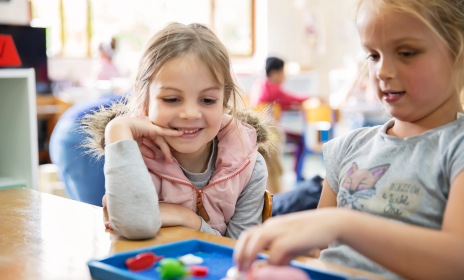
The children learn through hands-on work rather than listening to an adult speaking. They work using special materials that are designed to help them master skills or areas of knowledge and understanding, appropriate to their stage of development. The Montessori materials have been created and refined over the past 100 years.
Individual learning
Each child is unique therefore their experiences are different. The lessons are personalized and offered to individuals or small groups. This allows for individual interaction between the adult and children. The adult knows intimately what each child has mastered or where they need additional practice. The adult or directress mentors them towards ownership and responsibility for their own learning.
Freedom within the environment
The children have the freedom to work at their own pace, without interruption, choosing from a range of activities that are designed to help the child develop in totality. Freedom is a prerequisite for learning. A child (or adult) that is free, is one who has developed the potential to work out his own problems, yet can ask for and receive direction when necessary.
Discipline is the second prerequisite for learning. The discipline found in Montessori is an inner discipline – an inner control that the child develops in an ordered environment.
Freedom allows the children to make constructive choices of the materials and activities they wish to work with, developing motivation, concentration, independence, and inner discipline. The period from the ages of 3 – 6 is one of constructive perfection by means of activity. The hand becomes a prehensile organ of the mind. The children show an irresistible tendency to touch everything. They are continuously busy, happy; always doing something with their hands.
The result is that children develop concentration, confidence, self-discipline, and a love for learning. Studies have shown that these children do better academically.
“Man takes possessions of his environment with his hands”
– Maria Montessori.